
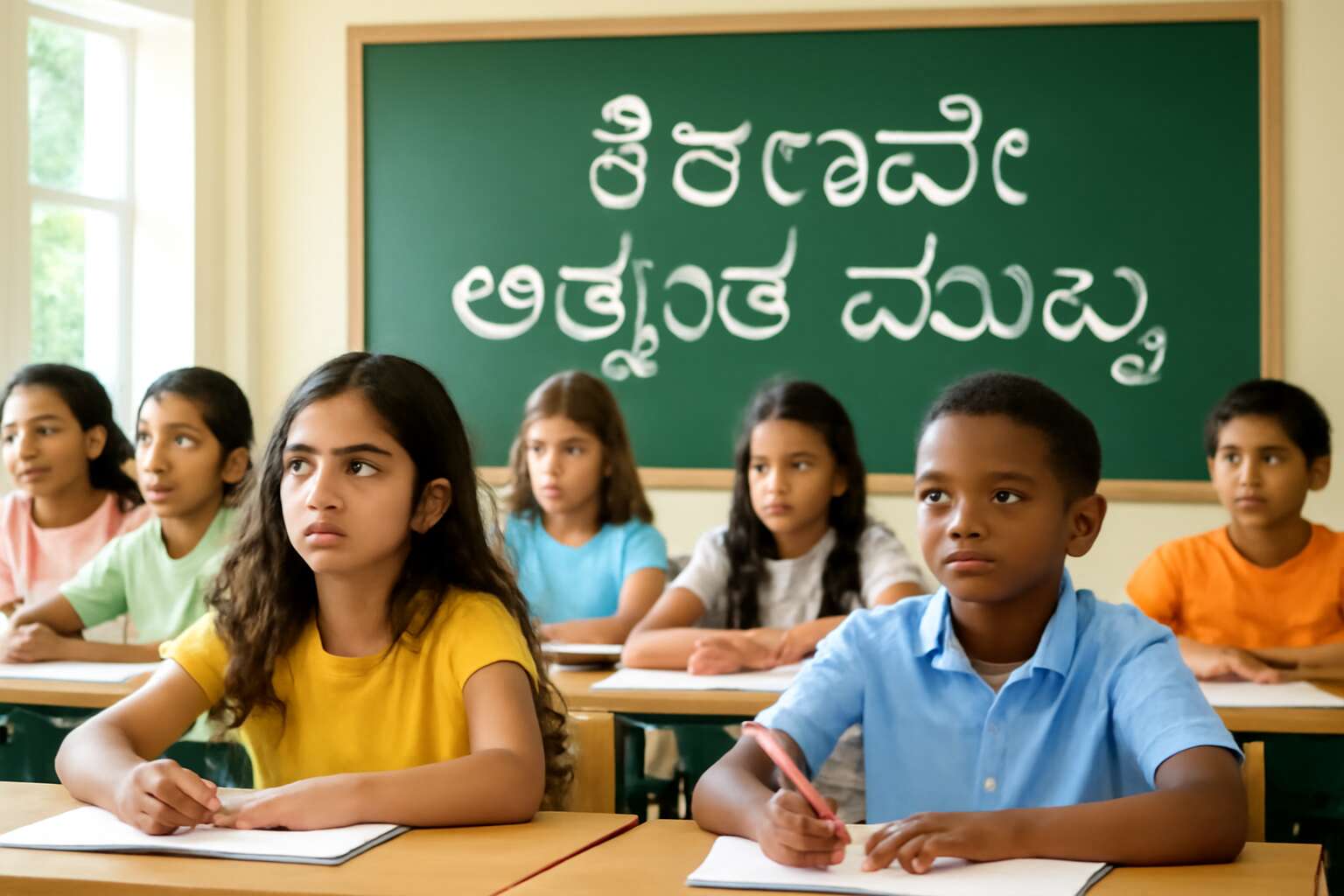
Kannada Meaning of Education: Core Concept
Definition of Education in Kannada
Nelson Mandela’s words echo across continents: education unlocks doors we didn’t know existed. In the Kannada landscape, the phrase education is most important kannada meaning opens a doorway to curiosity that travels far beyond classrooms.
What is education at its core? It is the deliberate shaping of mind and habit, a lifelong journey. In Kannada, the core concept of education translates to developing knowledge, skills, and discernment that empower daily choices.
To capture its essence, consider these facets:
- Knowledge acquisition
- Character and civic responsibility
- Critical thinking and problem-solving
Each facet interlocks to form minds ready for diligence, empathy, and innovation.
For readers in South Africa, education as a pathway to opportunity remains relevant, linking Kannada concepts to local aspirations and lifelong learning.
Literal vs. Figurative Meanings
In South Africa’s mosaic of languages and dreams, education is most important kannada meaning glows like a compass, guiding curious minds toward doors that open when study meets courage!
At its core, education is the deliberate shaping of mind and habit; in Kannada, that core concept translates to developing knowledge, skills, and discernment that empower daily choices.
Literal meanings anchor literacy and method; figurative meanings widen the horizon to curiosity, ethical judgment, and civic imagination.
- Literal foundations: literacy, numeracy, and disciplined study
- Figurative expansion: curiosity, discernment, and empathy
- Applied wisdom: problem-solving and responsible decision-making
For readers in South Africa, this Kannada-inflected lens links local aspirations to lifelong learning, turning doors into opportunities and knowledge into a shared lantern.
Key Kannada Terms Related to Education
To SA readers, Mandela’s spark lingers: ‘Education is the most powerful weapon you can use to change the world.’ In this SA–Kannada-inflected lens, education is most important kannada meaning glows as a compass, guiding curious minds toward doors that open when study meets courage!
As Kannada maps the journey, core terms translate intention into practice: Vidya (knowledge), Shiksha (education), Adhyayana (study), and Gnyana (wisdom). These terms ground learning in daily action rather than abstract ritual.
- Vidya — knowledge that informs daily choices
- Shiksha — structured learning and mentorship
- Adhyayana — disciplined study that builds character
For South African readers, the Kannada meaning of education becomes a shared lantern; I see its glow turning doors into opportunities and knowledge into communal strength. In classrooms, education is most important kannada meaning becomes a living practice.
Historical Evolution of the Kannada Concept of Education
Mandela’s enduring belief that education opens doors still lights South Africa’s classrooms. In Kannada, education is most important kannada meaning acts as a lantern, guiding curious minds toward opportunities that emerge when study meets courage.
The core concept evolves from Vidya (knowledge) to Adhyayana (disciplined study) and finally Gnyana (wisdom) that informs daily choices. Historically, Kannada education moved through distinct phases that shaped practice as much as belief.
- Ancient oral traditions and guru-parampara
- Medieval temple schools and structured mentorship
- Colonial-era institutions and the birth of modern schooling
- Post-independence reforms and the digital classroom
For South Africans, this lineage becomes a shared beacon—education as a practical force that turns inquiry into capability and community strength, not mere ritual.
Real-world Examples of the Kannada Meaning in Use
Education is the passport to the future, for tomorrow belongs to those who prepare for it today! In South Africa’s vibrant classrooms, that truth glows as a beacon for learners and mentors alike.
In Kannada, education is most important kannada meaning, more than a ledger of dates; it is a lantern that guides curious minds toward opportunity. The voyage runs from Vidya to Adhyayana to Gnyana, shaping daily choices as much as beliefs.
Consider real-world manifestations:
- Structured mentorship in temple schools, modern colleges, and vocational programs
- Community libraries and digital learning hubs in townships
- Practical applications of study in health, agriculture, and civic life
From this lineage, classrooms transform into laboratories of possibility, where inquiry meets courage and communities grow stronger together.
Linguistic Nuances and Translation Challenges
Common Translation Variants for Education in Kannada
In multilingual South African classrooms, 62% of teachers report translation gaps blunt comprehension. That gap shows how education is most important kannada meaning travels beyond textbooks into homes and markets.
Linguistic nuance matters: Kannada terms for education carry policy weight and everyday life texture. In my experience, such nuance matters, because teachers and families live with these words daily. Translators balance literal renderings with cultural resonance so the phrase lands with clarity in English while honoring Kannada readers’ lived experiences.
Common variants in translation emerge:
- Literal versus figurative renderings
- Register shifts between formal Kannada and accessible English
- Metaphorical versus technical usage in academic contexts
Readers notice the care with which terms travel between Kannada and English, revealing how education sits at the heart of daily struggle and small triumphs in rural life and urban classrooms alike!
Cultural Nuances in Kannada Education Terminology
Across South Africa’s multilingual classrooms, translation gaps blur comprehension and voice. The phrase education is most important kannada meaning anchors policy debates while traveling beyond textbooks into homes and storefronts, where families interpret school success through daily routines more than syllabi ever could.
Linguistic nuance matters: Kannada terms for education carry policy weight and texture of everyday life. Translators balance literal renderings with cultural resonance, ensuring the English lands with clarity while honoring Kannada readers’ lived experiences in both villages and cities.
Common variants in translation emerge as register shifts between formal Kannada and accessible English, and as metaphor versus technical usage in academic contexts. The result is a cadence that respects tradition yet speaks to contemporary classrooms and markets.
Readers notice the care with which terms travel between Kannada and English, revealing education’s central role in daily struggle and small triumphs across rural and urban horizons.
Common Translation Pitfalls to Avoid
“Education is the heartbeat that keeps a village alive,” a teacher once told me in a South African classroom where many languages mingle. The phrase education is most important kannada meaning travels from kitchens and kiosks to school boards, anchoring policy debates while echoing through daily routines.
Linguistic nuance matters: translators balance literal renderings with cultural resonance, ensuring the English lands clearly while honoring Kannada readers’ lived experiences. Common translation pitfalls—over-literal renderings, misaligned register, and erasing rural context—can mute the education’s central place in everyday struggles and small triumphs.
- Over-literal renderings that strip metaphor
- Register drift between formal Kannada and accessible English
- Losing rural-urban context
When done well, these choices turn a policy phrase into a living thread that connects classrooms, homes, and market stalls with equal gravity.
Kannada Script and Pronunciation Considerations
In multilingual South African classrooms, the phrase education is most important kannada meaning travels from kitchen tables to school boards, insisting on accuracy and empathy. Linguistic nuance matters: Kannada script with looping consonants, conjuncts, and diacritics rewards careful mapping into English, rather than a stiff literal swap. Translators balance literal renderings with cultural resonance, ensuring the English lands clearly while honoring Kannada readers’ lived experiences.
- Kannada script intricacies: diacritics and conjuncts challenge direct transliteration into English.
- Pronunciation considerations: preserving regional speech patterns to avoid misinterpretation.
- Register and tone: maintaining rural textures without drifting into formalism.
When done well, these choices turn a policy line into a living thread that connects classrooms, homes, and market stalls with equal gravity. Observers have seen communities respond differently when cadence respects rural rhythms and the spareness of everyday life.
Applications in SEO Content for Kannada Audience
Keyword Research Strategies for Kannada Education Content
In a sun-warmed rural classroom, a single idea travels faster than the school bus: education can lift a family from hardship. The Kannada meaning of education carries that promise for many readers, and the phrase education is most important kannada meaning underscores how language shapes belief across cultures.
Applications in SEO Content for Kannada Audience center on weaving Kannada with English to meet readers where they are. Localized stories, respectful cultural cues, and natural usage build trust; the phrase education is most important kannada meaning anchors search intent with heart.
Keyword Research Strategies for Kannada Education Content include these notes:
- Explore long-tail Kannada phrases in Kannada script and Latin transliteration.
- Assess regional dialects and everyday schooling terms to fit user intent.
Across South Africa, language-woven education stories feel intimate and true, turning pages into pathways of opportunity.
On-page SEO: Meta Titles, Descriptions, and Headers in Kannada
A punchy meta title can tilt the click in under two seconds, and in a multilingual South African feed that choice often flips between English and Kannada. For an article about education is most important kannada meaning, a focused on-page SEO approach makes the difference between skim and soak.
On-page Kannada optimization means Meta Titles, Descriptions, and Headers in Kannada, with subtle English where it helps readability. Use Kannada script to honor local search habits, then sprinkle transliterations to bridge readers who skim in Latin characters. This blend anchors search intent with heart.
Key on-page elements to wield gently:
- Meta Titles (Kannada script + optional transliteration)
- Meta Descriptions that promise value in both tongues
- Header tags in Kannada to structure the content clearly
In South Africa, this approach feels authentic and accessible, turning a technical task into a cultural handshake.
Content Structure and Readability for Kannada Readers
In South Africa’s multilingual digital space, readers engage more deeply with content anchored in native scripts. A recent study shows Kannada-script (ಶಿಕ್ಷಣ) pages hold attention longer and connect with local realities more effectively.
Applications in SEO content for a Kannada audience hinge on structure and readability. Use Kannada script for core phrases, sprinkle transliterations to ease skimming, and balance meta titles and headers in Kannada with subtle English where it aids comprehension. The phrase education is most important kannada meaning appears as a guiding note for explanations.
- Meta titles in Kannada; concise, readable, and aligned with search intent.
- Headers in Kannada to create clear, navigable sections.
- Paragraphs with varied lengths to mirror the rhythm of rural life and daily speech.
Internal Linking and Related Terms in Kannada SEO
South Africa’s multilingual digital space rewards native-script content; Kannada pages capture attention longer, especially when core ideas sit beside English for quick skimming. A recent study notes that Kannada-script (ಶಿಕ್ಷಣ) pages hold attention longer and connect with local realities more effectively. The guiding line is ‘education is most important kannada meaning’ that anchors explanations and invites deeper exploration.
In practice, Applications in SEO content for Kannada audiences hinge on structure and readability. Use Kannada script for core phrases, sprinkle transliterations to ease skimming, and balance meta titles and headers in Kannada with subtle English where it aids comprehension. Focus on internal linking (ಆಂತರಿಕ ಲಿಂಕ್) to connect related Kannada terms—education in Kannada content, and linked topics like ಪಾಠಶಾಲೆ, ವಿದ್ಯಾರ್ಥಿ, and ಅಲ್ಲಿ— ensuring smooth navigation across sections.
- ಆಂತರಿಕ ಲಿಂಕ್ (internal linking) fosters seamless navigation
- Related Kannada terms: ಶಿಕ್ಷಣ, ಪಾಠಶಾಲೆ, ವಿದ್ಯಾರ್ಥಿ
- Localized schema and metadata for Kannada queries
Practical Examples and Use Cases
Educational Policy and Curriculum in Kannada Context
Across South Africa’s diverse classrooms, practical examples bring a powerful truth to life: education is most important kannada meaning resonates when learning is rooted in local experience. Teachers anchor lessons in community contexts—Kannada-inspired storytelling, bilingual problem-solving, and service projects—so ideas move from chalkboard to real impact. This approach makes education a living force that shapes futures, not a distant ideal.
- Kannada-language literacy programs and community tutoring that translate theory into everyday skills.
- Bilingual projects in science and social studies, connecting local realities with curriculum goals.
Educational policy and curriculum in Kannada context emphasizes inclusive language education, with schemes for Kannada-medium schools, bilingual bridges, and culturally relevant materials. A robust policy framework supports teacher development, assessments in Kannada, and collaboration with local communities to keep content authentic.
Practical Topics and Example Lessons in Kannada
Across South Africa’s varied classrooms, practical Kannada-inspired lessons anchor learning in real life. Teachers blend story, local context, and hands-on tasks to transform theory into usable skills. In local parlance, ‘education is most important kannada meaning’ denotes more than classrooms; it denotes everyday readiness for community life.
Examples of practical topics and example lessons include:
- Kannada-language literacy stations built around local folktales and service projects
- Bilingual science and social studies activities linking local ecology or history to curriculum goals
- Community tutoring programs where learners mentor peers and translate theory into daily tasks
The approach champions inclusive language, local voices, and authentic assessment, ensuring the Kannada context remains lively rather than dusty.
Cultural Proverbial Wisdom on Education in Kannada
Education is a voyage, says a local elder, and in South Africa’s multilingual classrooms that voyage often begins at the doorway. So the phrase education is most important kannada meaning travels beyond translation, rooting learning in daily life and community rhythms.
Culture carries wisdom in Kannada that smiles at perseverance and service. In use today, proverbs and stories anchor practical learning.
- Proverb-led storytelling circles linking language, literacy and local service
- Elder-story sessions paired with local ecology or history projects
- Peer mentorship that translates theory into daily tasks in Kannada terms
In a sunlit classroom near a busy market, a teacher threads a Kannada verse through a math puzzle, and chalk dust becomes a constellation of connections. Children discover that numbers can speak Kannada, and stories give structure to symmetry.
An atmosphere of inclusive language and authentic assessment keeps the Kannada context vibrant—like a living manuscript that welcomes every reader.
Case Studies: Communities Emphasizing Education in Kannada-speaking Regions
In Kannada-speaking communities, literacy grows where elder stories braid with math beside the marketplace. In South Africa’s multilingual classrooms, Kannada threads remain a compass for curious minds. A local elder says, ‘Education is a voyage,’ a motto that carries the Kannada meaning education is most important kannada meaning through daily life and community rhythms. Children translate abstractions into action as chalk lines at stalls map geometry to real trades.
- Coastal Karnataka stories around fishing boats: elders narrate ecological terms in Kannada while kids map seasons to fractions and budgets.
- Rural towns pairing harvest calendars with simple experiments in soil, rain, and crops; elders mentor with Kannada glossaries and hands-on tasks.
- Urban Kannada-speaking neighbourhood after-school circles linking local history to language arts, peer mentoring, and service projects.
This approach shows education is most important kannada meaning, translating theory into everyday acts that sustain a vibrant community.